
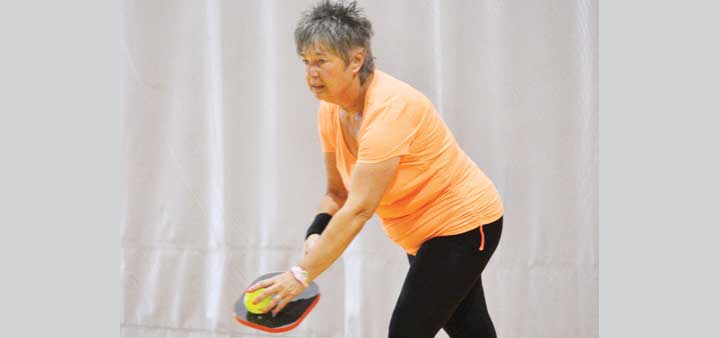
With a quick underhand swing, the bright yellow wiffle ball makes its way over the net and returns again before you can even blink.
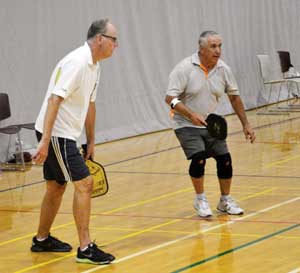
The sound of the solid wood paddle making contact with the ball echoes through the gymnasium where hundreds of Pickleball players have congregated. Playing in pairs on a badminton-sized court, players send wiffle balls back and forth to each other with paddles, earning points as they go, explains Bruce Doughty, president of the Pickleball Association of Ontario.
Think badminton, tennis, and table tennis combined.
Doughty says players in ranked tournaments are ranked on a scale of 2.5 to five.
“The only real difference between the rankings is consistency of points,” he says.
Invented in 1965 as a children’s backyard game on Bainbridge Island, outside of Seattle, the sport is growing increasingly popular, especially with the older adult community.
The story of its inception goes like this: Congressmen Joel Pritchard, William Bell and Barney McCallum had just returned home from a game of golf one day to find their kids bored and restless, so they decided to create a game that would keep them busy during the summer months when school’s out.
“They handed the kids ping-pong paddles and a wiffle ball, and lowered the net on their badminton court. In the coming days, both kids and adults alike fell in love with the game. As they played, the rules evolved (to include the non-volley zone, for instance) and solidified to their present incarnation,” states Pickleball Inc.
From there, it took off across Canada and the U.S.
The sport is now played all across Ontario, with clubs meeting on a weekly, bi-weekly and monthly basis. Tournaments are a large part of the sport.
According to Pickleball Ontario, there are more than 100 spots where the sport is being played across the province.
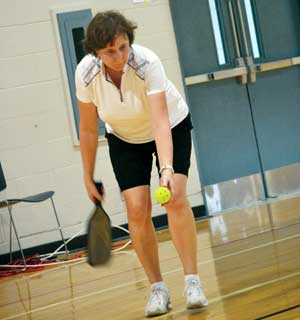
The ball, which has holes and is slower-moving than a traditional tennis ball, is served underhand diagonally starting with the right-hand service-square, and points can only be scored by the side that serves.
Players on each side must let the ball bounce once before volleys are allowed, and there is a seven-foot no-volley zone on each side of the net, to prevent “spiking.”
Points are scored by the serving side only and occur when the opponent faults (fails to return ball, hits ball out of bounds, etc.).
The first side scoring 11 points and leading by at least two points wins.
If both sides are tied at 10 points, then play continues until one side wins by two points.
The net is placed at 36 inches, Doughty explains. It’s typically played in doubles, but can be played in singles as well, with ladies, mens or mixed categories.
“It’s a lot of fun. It’s a high-cardio workout,” Doughty says. “It’s really taken off.”
At an Oshawa tournament, players from Durham, Windsor, Peterborough, and Brampton took part.
“People are interacting, people are social and they’re exercising. It’s fun,” says Doughty. “It’s a great sport, even for younger people.”
And while the majority of players at the ranked tournament were adults, the sport is growing more popular with the younger crowd as well.
There was even a father and son pair.
“All it takes is a pair of court shoes, a badminton net that they lower down and some paddles,” the association president says.
To check out pickleball, visit the Pickleball Association of Ontario’s website at pickelballassociationofontario.org to find an interactive map displaying where the sport is played and when.
“People can go on it and find a place to try it out,” Doughty says.
The 2015 Pickleball Canada Eastern National Open Championship, one of the bigger tournaments, will be held in Waterloo in July.