
By Dave Flaherty/Active Senior’s Digest
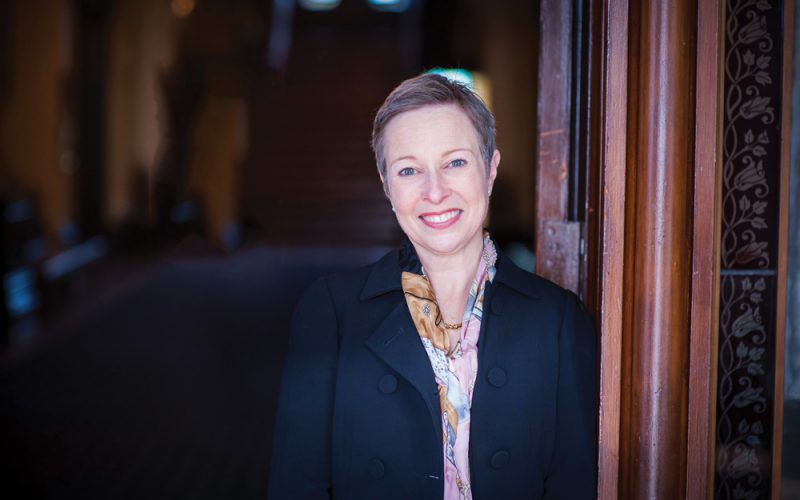
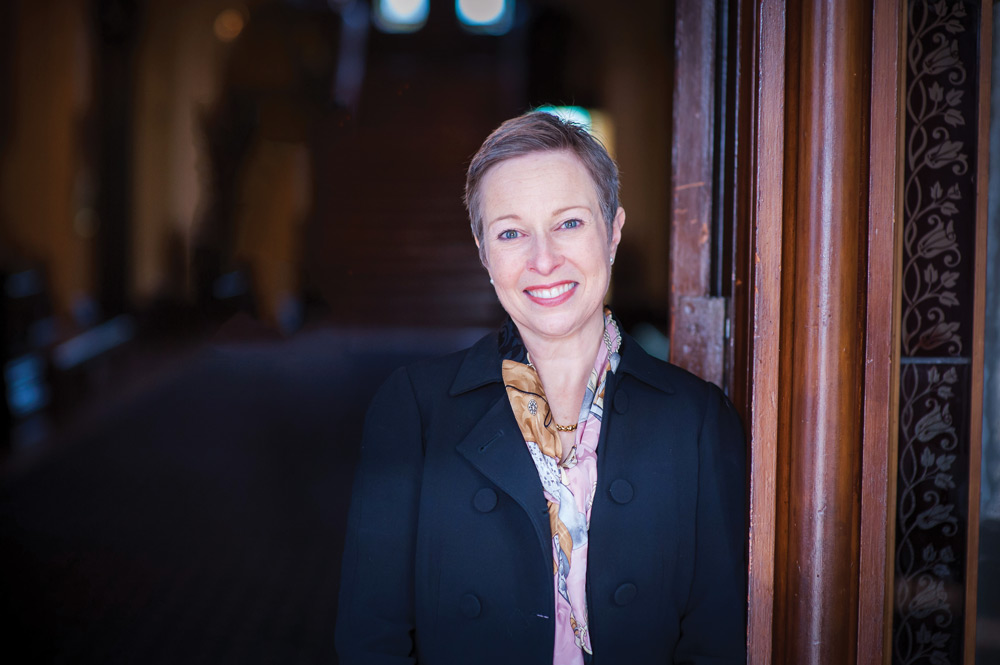
As an educator, Dr. Leanne Foster has been helping to mold young minds for decades.
But her character goes well beyond education.
She is a mother, a lover of animals, and a cancer survivor.
Foster is the current head of school at Trafalgar Castle School in Whitby, an independent all-girls school with roots going back more than 140 years.
A veteran educator in both the public and independent school systems, Foster took over her current post heading into the 2015 fall semester.
Classes were out when Active Senior’s Digest spoke with her, but she warmly greets some children taking part in a summer camp at the school.
After they head off, Foster leads the way to her spacious office.
Her pride in Trafalgar Castle School is apparent, but she recalls it wasn’t exactly an easy decision to make when a colleague told her about the open position there.
She was at St. Clement’s School, an all-girls school in Toronto, for some time, and was very fond of it.
“I loved my job at St. Clement’s. My house was a 10-minute walk away from the school, and I wasn’t sure if I wanted to make that move,” Foster says.
However, when she started researching Trafalgar Castle, her mind was quickly made up.
“I have to say the minute I started learning about the school, and the minute I met the girls, I just fell in love, and realized this is where I wanted to be,” she says.
So Foster and her family, including her husband, mother, and daughter, along with their pets, uprooted themselves from the familiar surroundings of Toronto and headed east on Highway 401.
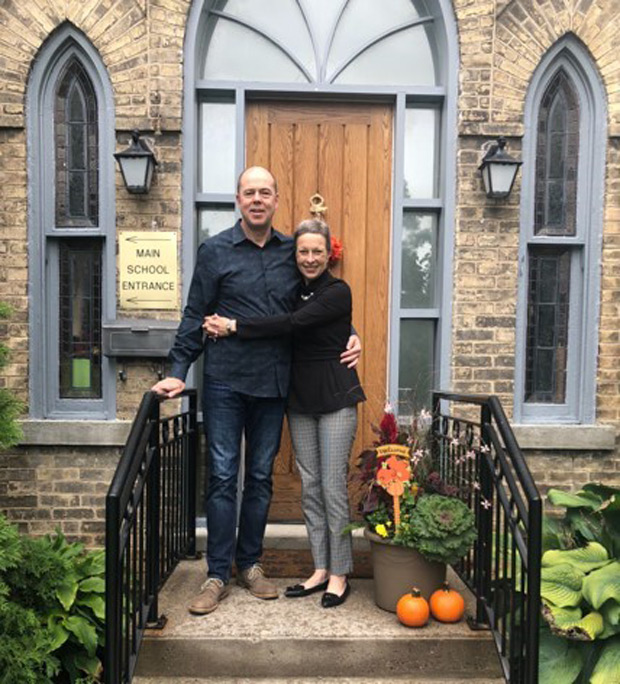
She says her husband was more than willing to make a sacrifice for her to further her career.
“[He] works at Yonge and Eglington, a 15-minute walk from where our house was, so he really loves me,” she says with a laugh. “For four-and-a-half-years, he’s taken the GO Train every day.”
But only a few months after this life-altering – but exciting – move, Foster’s entire existence was shaken to the core.
In November 2015, she received a diagnosis of breast cancer.
Calling it a “complete shock,” Foster had only six months earlier received a clean bill of health during her annual mammogram.
“Cancer does not run in my family, and like many women, I was very diligent and careful about myself,” she says.
“To find out I had breast cancer really threw me.”
Foster admits her initial reaction was shock, then absolute fear.
“The first thing I thought of was my daughter, and my ability to be there for her future,” she says.
After the shock wore off, Foster decided the best thing she could do was to fight, but with a realistic view.
“I just decided I did not know what the future was going to hold, none of us do, but I was going to do anything I could in my power to become and remain healthy. I just decided I was going to be well,” she says.
But she couldn’t do it alone.
Along with her family, close friends and the Trafalgar school community, she moved forward.
She also found a powerful ally in the team at Hearth Place Cancer Support Centre in Oshawa, an organization she considers herself forever indebted to, as she sits on the board of directors.
Her passion for Hearth Place is just as apparent as that for her school.
She notes she met a “wonderful community of other women with breast cancer” through Hearth Place and she continues to be in regular contact with them as they move forward together.
In terms of her care during treatment, Foster raves about the service she received at Lakeridge Health.
“I want to say the level of care I received through Lakeridge was exceptional, I can’t even believe to begin to thank that organization,” she says.
While she was receiving cancer treatments, Foster decided she would continue working as she had just begun at Trafalgar Castle School.
She says this was a “personal choice,” but it “certainly is not the right one for everyone.”
While the disease caused her hardship, Foster says she is now healthy, and the experience has given her a different view of life in general.
“It sounds like a cliché, but anyone who experiences cancer or any type of serious illness will understand when I say it gives you an appreciation for your day-to-day… it teaches you not to sweat the small stuff.”
This is a message Foster has tried to instill in her students and their families.
“Focus on what is important,” she adds.
In addition to the support from her loved ones, Foster candidly says her faith helped her as well.
“Knowing there were thoughts and prayers from many people far and wide helped me stay optimistic and hopeful,” she says.
Faith was an important factor in her upbringing.
Foster grew up in the Salvation Army Church and points to it as a defining factor in who she is.
“It shaped who I am, and shaped my will to be resilient, and my dedication to compassion and giving back,” she says.
The faith Foster grew around was what she calls a “quiet expression of Christianity.”
“The way in which our faith was expressed was through helping each other. In my home, we were open to other religions and other cultures. It was a very non-judgmental approach to religion,” she explains.
And while she came from a loving family, it was also one that was always on the move.
In her youth, Foster says she attended 11 schools in the Toronto-area, often having to relocate due to her father’s employment.
She believes this life experience lets her understand how new students feel when they come to Trafalgar and may not know anyone.
“I’m always conscious of that when new girls come into the school.”
For as long as Foster can remember, she always wanted to become an educator.
“From the time I was little, I just really wanted to be a teacher. I used to line up my dolls, and my teddy bears, and sometimes my younger sister, and play teacher. It’s just something that was always of interest to me,” she says.
Going back to her upbringing in the Salvation Army Church, which puts an emphasis on helping others and giving back, she says a teaching career was the perfect fit.
“Education just seemed to meet all those goals, and was something I was passionate about,” she says.
Her love for teaching was nurtured by two women who served as role models.
The first was Grace Procunier, who taught Foster at Annette Public School in Toronto.
Interestingly enough, Mrs. Procunier had taught her mother as well.
“My mother encountered her at the beginning of her career, and I had Mrs. Procunier towards the end of her career, and it was just very special.
Foster says she loved Procunier’s focus on things such as “sound-old fashioned penmanship, poetry and really making sure we had a good education.”
“She just meant the world to me. She was gracious and creative, but also upheld very high standards,” Foster notes. “She was just someone who made me feel so excited about showing up every day.”
Pat Parisi influenced Foster both as a teacher and later on as a colleague.
“She had such an impact on me. She was rigorous and demanding but incredibly kind.”
Parisi, as head of school at St. Clement’s
in Toronto, would hire Foster years later.
“It’s because of Pat Parisi, in many ways, that I’m in the role at Trafalgar because she was so encouraging of women to pursue higher education, and to also go for the dream job.”
But Foster’s career in teaching did start with some obstacles.
After graduating from university, Foster was faced with a situation that evokes the old saying, “If you love something, let it go. If it comes to back to you, it’s yours forever. If it doesn’t, then it was never meant to be.”
“It was a time in Ontario when teachers were being laid off, it’s a little similar to what is happening now,” Foster recalls.
Her father encouraged her to take another path for the time being.
“His comment to me was, “If you’re really meant to be a teacher, you’ll find your way back. But for now, go explore other opportunities,” she says. “It was the best advice ever because I ended up spending eight years in publishing.”
During that time, Foster moved abroad and lived in places such as the U.K., France, and Germany.
And while she was successful in publishing, becoming a partner made her yearn for something different.
“I thought about what I do really want to do. Having my daughter made me realize I wanted to model for her what was important in life,” she says. “My dad was right, I sort of found my way back, and it was my first love and my true passion, and I haven’t looked back since.”
She took on her first job as a junior-senior kindergarten teacher at Bedford Park Public School in Toronto, later moving into special education with the Toronto District School Board
After a stint as a special education consultant, Foster took a leave to complete her PhD.
With autism services being a hot topic in Ontario, Foster says special education was looked at differently in the late 1990s.
“What was different back then, was a sense of possibility. We were beginning to understand the very specific needs of children with autism, for example,” she says. “Having a child with autism is very different than a child with dyslexia, or a child with Down Syndrome.”
Foster says education boards were putting more specialists and training in place for special education, but concedes there was always a need for more resources.
“When things break down, it is usually due to a lack of adequate resources or a lack of adequate training. It’s rarely, in my opinion, because a teacher doesn’t want, it’s often because a teacher simply doesn’t know how to.”
For parents at the time, Foster says they were realizing there is “no shame” in having a child with a learning disability, and the benefits of having assessments for their children were becoming more apparent.
When Mike Harris and his Conservative government took power in 1995, many in education deemed it a dark time for the school system in Ontario.
Foster says the biggest challenges were, again, due to resources spread too thin.
“The ability of smaller school boards to really address the needs of the families in their schools was being undermined through amalgamation,” she says.
She witnessed this as the East York Board of Education merged into what became the Toronto District School Board, a “massive” organization.
While the Harris regime had a contentious relationship with educators just as the current Ford government has, Foster believes things were a bit clearer.
“We knew what the Harris government was coming in with. There was, perhaps what I would call, more transparency coming forward,” she says. “I think it was still very fraught and still very contentious, but I think there was no doubt what we were signing up for through the election.”
With that said, Foster doesn’t necessarily believe the “current government is wrong in saying many boards are currently top-heavy,” but thinks further amalgamation will just create more pressure that can’t be handled.
While she works at an independent school, Foster says she is a “huge supporter” of public education.
“I think every single Canadian should be a supporter of the public education system whether your children are in an independent school or not,” she says. “I think the foundation of a good society is our education, and I was very proud to be part of public education.”
But eventually, Foster was drawn to independent schools, first with Branksome Hall, an all-girls school in Toronto.
“I was hired to expand its special education program. It was just a wonderful opportunity to be able to take something, and grow it,” she says.
She points out there are distinct differences between independent schools and private schools.
“Anyone can start a private school by paying a fee,” she explains.
Schools such as Trafalgar Castle are run as a non-profit and are registered with the Conference of Independent Schools of Ontario, and the Canadian Accredited Independent Schools.
“Those two bodies work very hard collaboratively to ensure a lot of transparency and a lot of accountability,” Foster says.
Trafalgar Castle is overseen by a board of directors and is financially supported through tuition and donations from families.
But Foster points out, different than in Quebec and Alberta, provincial funding allotted for children who are attending independent schools in Ontario still go to public boards.
“In many ways, independent schools are lessening the burden on the public school system. We are not taking dollars away,” she says.
This is a system that Foster believes is quite fair.
“Absolutely. We are not looking for handouts from the provincial government, and I think the two [school systems] can exist side-by-side quite well,” she says.
Away from school, Foster is a strong supporter of the local arts and culture scene, particularly music.
“I am just passionate about music. My husband and I love going to the Regent Theatre in Oshawa, and the Courthouse Theatre in Whitby.”
Finishing off, Foster says she is a huge lover of animals, especially her dogs.
With a cancer diagnosis behind her, the present and the future are the focus for Foster.
“I was blessed enough to have the opportunity to have many more years, and I was determined I was going to use those years well.”