
By Sadia Badhon/Active Senior’s Digest
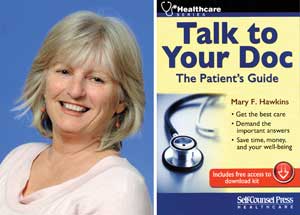
With rising demands on the health care system, doctors may not have as much time as they once did to help patients. One thing that can lead to a better visit, however, is better communication. According to Mary Hawkins, a communications lecturer at the University of Ottawa, columnist and author of Talk to Your Doc: The Patient’s Guide, communication plays the biggest role in how an individual’s experience will be with their doctor.
Seniors’ Digest:There are eight sections in the book, including The Changing Health-care System, Knowing Yourself, and Understanding Your Relationship with Your Doctor. Are any of them more important than the other?
Hawkins: I think they’re all important, to different degrees, of course. Communicating with your doctor and having strategies to do that is important, but I think it’s also important first to know yourself as a patient and what kind of patient you are. Also, how do you gather information when your doctor is telling you information? Are you an audio learner? Are you a visual learner? In other words, do you need to bring a notepad with you? Do you have to ask the doctor to repeat themselves? How do you perceive and organize and interpret information?
Of course, it depends on your situation. If you are the main caregiver for somebody, then you have to develop strategies in terms of communication on behalf of others.
Senior’s Digest: How much of a role does communication play in how someone’s experience will be with his or her doctor?
Hawkins: I would say it’s 100 per cent because part of communication is not just how you speak, it’s your tone of voice. Your tone of voice would influence the degree of importance and health concern for you. Also, being able to articulate in writing. I always suggest to patients that they should bring a list of their symptoms because today, doctors will sometimes say to the patient, “You only can speak about one thing.” Well, sometimes for the patient, it’s difficult to know the difference between the symptom and the actual problem. So I think you should write down your list of symptoms, such as, you have an ache in your back.
Use adjectives such as, do you have a pins and needles feeing in your stomach? In other words, when you walk, do you feel pain in your hip? OK, what kind of a pain? Is it a pinching pain? Is it a nerve pain? Is it just stiffness?
Using adjectives is important when you make your list because then when the doctor takes a look at that list, they can then decipher from those various symptoms if it is one or two problems.
Senior’s Digest: What are some of the biggest challenges seniors face when trying to talk to their doctors?
Hawkins: Seniors today, even though they’re the boomer generation, they still may have difficulty speaking up on their own behalf because they were raised by parents that told them, you know, don’t challenge certain authority. Even though those seniors are now in their 60s, that message is still sometimes deeply engrained in them.
If you can’t speak up, using that notepad or that list, let’s say, maybe five to 10 items, using that as a reference point is important. One of the other challenges, sometimes, is getting the doctor to listen or make eye contact with you.
If the patient is feeling the doctor is not really listening, it’s very fair to ask the family doctor, “You know, I really would like to see a specialist.” If the family doctor is resistant to that, take a stand and basically repeat it. “You know, I really would feel more comfortable with that.”
Senior’s Digest: How can those challenges be met?
Hawkins: Reflecting on what it is you want to discuss with the doctor and making key points that you want to present to the doctor on a piece of paper and then being able to have a discussion with the doctor about that. Again, doctors are people and they have different personalities too, so if you don’t have a doctor who is open on that level, then you have to develop strategies to get the most information out of them.
Senior’s Digest: What tips would you give to seniors to help them better communicate with doctors? Are there any programs in place to assist seniors with the communication barriers?
Hawkins: Even before they go to the doctor, they need to sit back and think about what it is they’re going to the doctor about. What are their health concerns? I think they also need to know and mention what heredity lies in their family. Meaning, you know, if the parents had cancer or diabetes or heart disease. That’s information they need to lay out.
I think also if a senior finds it difficult communicating these things to a doctor, they need to bring an advocate with them. They need to inform that advocate of what their concerns are so the advocate can then help them along in terms of communicating what their needs are. An advocate can be somebody they really trust, a friend, preferably somebody who is articulate, not somebody who is aggressive but somebody that is willing to speak up.
Senior’s Digest: What are some special challenges seniors face with communicating with their doctors now that they didn’t have five or 10 years ago?
Hawkins: A lot of doctors today are in a rush. So because they’re in a rush, that’s another important reason why the patient has to be more precise in their communication and informed in their communication. That’s why you need to know yourself. That’s why you need to reflect on what kind of a pain you are having.
One way to learn more about symptoms is to do research. Going to the library, even to look up information if you’re not a technical person, and looking up information there. The librarian will also help you and get the information. Talking to people, talking to friends, watching TV, certain health shows, they might have information, listening to the radio, telemedicine health line and nurse for additional information. I think keeping in touch with the outside community on that level is very important.


